
Cleaning HVAC Systems in an Occupied Hospital: NADCA ACR 2025, ICRA 2.0, and How to Avoid an Infection Control Finding
Cleaning a hospital air handler is a maintenance task with an infection control permit attached. Here is what NADCA's 2025 standard requires for containment and verification, where the work lands on the ICRA 2.0 matrix, what CDC actually says about duct cleaning, and the project sequence that keeps a coil cleaning from becoming a survey finding.
“Clean the ducts” is a simple request that goes wrong in two directions. The first is cleaning that creates an exposure: a contractor pulls a loaded filter with the fan running, or opens a return plenum above an oncology unit without containment, and the dust that was sitting harmlessly in the duct is now in the air. The second is cleaning that removes nothing: a truck, a hose, a video, and an invoice, with the coil still fouled and the exhaust duct in the isolation wing still half blocked.
Two documents govern doing it right. NADCA’s ACR standard, reissued as the 2025 edition in September 2025, defines what cleaning is and how to contain and verify it. ASHE’s ICRA 2.0 matrix defines the precautions a hospital requires before anyone opens the system. This article covers both, along with what CDC actually says about duct cleaning in healthcare and the sequence we follow on every hospital project.
What CDC Actually Says About Duct Cleaning in Healthcare
We would rather you hear this from us than from a competitor’s sales deck. CDC’s Guidelines for Environmental Infection Control in Health-Care Facilities state that duct cleaning has benefits for system performance, but its usefulness for infection control has not been conclusively determined, and that no data indicate duct cleaning beyond what is recommended for optimal performance reduces the risk of infection.
The same guideline also says the following, with recommendation categories:
- Clean ventilation ducts as part of routine HVAC maintenance to ensure optimum performance (Category II).
- Prevent dust accumulation by cleaning air-duct grilles according to facility-specific procedures and schedules, when rooms are not occupied by patients (Category IC, II).
- Ensure HVAC filters are properly installed and maintained to prevent air leakage and dust overloads (Category IB).
- Bag dust-filled filters immediately upon removal to prevent dispersion of dust and fungal spores during transport (Category IB).
- Coordinate HVAC maintenance with infection control staff to allow relocation of immunocompromised patients if necessary, coordinate system start-ups to protect PE patients from bursts of fungal spores, and allow sufficient time for air changes to clean the air once the system is operational (Category IC).
And in the background text: accumulation of dust and moisture within HVAC systems increases the risk for spread of healthcare-associated environmental fungi and bacteria; infrequent cleaning of exhaust ducts in airborne infection isolation areas has been documented as a cause of diminishing negative pressure and reduced air changes; and bursts of organisms can be released on system start-up after stagnation.
So here is our position, and it matches CDC’s. We clean hospital HVAC systems to restore performance: air changes, pressure relationships, coil capacity, and drain pan drainage. We remove the reservoirs of dust and moisture that the guideline identifies as risk factors. We do not sell duct cleaning as an infection control intervention, and a contractor who does is telling you something about how carefully they read.
NADCA ACR 2025: What It Requires
ACR, the NADCA Standard for Assessment, Cleaning, and Restoration of HVAC Systems, was reissued in September 2025 and supersedes all earlier editions. It is the standard of care for the industry and a free download from NADCA. The requirements that matter most inside a hospital:
Source removal is the method. Cleaning means dislodging non-adhered substances from the airside surface with a suitable agitation device and capturing the dislodged debris with vacuum collection equipment operated continuously during cleaning. Fogging, spraying, or “sanitizing” without agitation and capture does not meet the standard’s definition of cleaning.
Engineering controls are mandatory. Any vacuum collection equipment exhausting inside the building envelope must use HEPA filtration at 99.97 percent efficiency at 0.3 microns. A continuous negative pressure must be maintained in the portion of the system being cleaned relative to surrounding spaces, verifiable at representative locations during the work. Equipment without HEPA filtration must exhaust outdoors.
Containment has four levels. Level 1 (negative pressure on the component being cleaned) is the minimum for every project. Level 2 adds polyethylene containment barriers (6-mil fire-retardant sheeting recommended, with a required two-layer floor), a manometer or airflow device to validate negative pressure, HEPA air scrubbing of the work area at a minimum of four air changes per hour, and, in healthcare environments, a post-remediation verification before the containment comes down. Level 3 adds a decontamination chamber, a background particulate baseline before containment, and a stop-work rule if airborne particulate exceeds background. Level 4 adds a two-chamber decontamination unit and a constant recording pressure monitor with an alarm.
Every component gets cleaned, not just the duct. The standard covers air handler filters and bypass, coils, condensate pans and drain lines, humidifiers, fans, dampers, mixing and VAV boxes, reheat coils, return plenums, and exhaust ductwork. Coils must be accessed on both the upstream and downstream faces. Drain pans and lines must be cleaned, flushed, and tested for drainage before and after. Dampers are marked before cleaning and restored to the marked position afterward. Registers, grilles, and diffusers are removed where possible, cleaned, and reinstalled.
Cleanliness is verified, not assumed. Verification happens immediately after cleaning and before the system is restarted, by one of three methods: visual inspection (visibly clean means free of non-adhered substances and debris), the surface comparison test, or the NADCA Vacuum Test, where a 100 square centimeter template sample is analyzed by NIOSH Method 0500 and passes at 0.75 milligrams or less of debris. If a visual result is disputed, the quantitative methods settle it.
Surface treatments come last, if at all. Coatings may be applied only after the system has passed cleanliness verification, must meet UL 181, and every chemical product must be used strictly per its label. EPA registers only a small number of sanitizers for the inside of bare sheet metal ducts and none for fiberglass duct board or fiberglass-lined ducts, and NADCA’s position paper on chemical products reminds contractors that using a product in a manner inconsistent with its label is a violation of federal law. Treat a “duct sanitizing” pitch accordingly.
The standard recommends annual inspection for healthcare systems: air handlers, supply ducts, and return and exhaust ducts each year, with cleaning triggered by findings such as visible particulate, compromised performance, water damage, construction debris, microbial growth at Condition 2 or 3, or deteriorating fibrous glass liner.
ICRA 2.0: Where HVAC Cleaning Lands
ASHE’s Infection Control Risk Assessment 2.0 (released 2021, form revised May 2022) is the matrix most hospitals in our territory use, and it explicitly covers maintenance. Step 1 classifies the activity; Step 2 classifies the patient risk of the area; Step 3 gives the class of precautions; Step 4 assesses the surrounding areas the work will affect.
| Activity type | Definition (condensed) | HVAC examples (our classification) |
|---|---|---|
| Type A | Inspection and non-invasive activities; limited building system maintenance that does not create dust or debris | Ceiling tile lift for inspection, filter gauge readings, damper visual check |
| Type B | Small-scale, short duration activities creating minimal dust | Work above the ceiling, access to mechanical chases, fan shutdown and startup |
| Type C | Large-scale, longer duration activities creating moderate dust; any activity that cannot be completed in a single shift | Multi-night air handler and duct cleaning, coil restoration with containment |
| Type D | Major demolition and construction; removal or replacement of building system components | Air handler replacement, duct replacement |
| Patient risk group | Type A | Type B | Type C | Type D |
|---|---|---|---|---|
| Low (offices, mechanical rooms, public corridors off clinical units) | I | II | II | III |
| Medium (waiting areas, SPD dirty side, kitchen) | I | II | III | IV |
| High (patient rooms, acute care units, ED, pharmacy, labs, diagnostic imaging) | I | III | IV | V |
| Highest (ORs, ICUs, transplant and oncology units, SPD clean side, pharmacy compounding, isolation units) | III | IV | V | V |
Three notes from the matrix change how HVAC work gets planned. An infection control permit is required for Class III (Type C) and all Class IV and V work. Any condition involving sewage, mold, asbestos, or gray or black water automatically elevates to Class IV for low and medium risk areas and Class V for high and highest. And the two Class III cells that involve heavier work (Type C in a medium risk area, Type D in a low risk area) are elevated to include the negative air exhaust requirements of Class IV whenever the work area cannot be sealed and completely isolated from occupied patient care space.
The classification question specific to HVAC is this: the air handler sits in a mechanical room (Low risk), but its ductwork runs into ORs and ICUs (Highest risk). Step 4 exists for this situation. The precautions follow the areas the work affects, not the room the technician is standing in. In practice, most infection preventionists we work with classify air handler and duct cleaning serving critical spaces as Type B or C work against the Highest risk group, which lands at Class IV or V. Plan for that, and let your IP downgrade it if the scope justifies.
What Class IV requires, condensed from Table 5 of ICRA 2.0: barriers to the ceiling, or to the deck above where ceiling tile is removed, built without releasing dust, or an approved containment unit with HEPA-filtered exhaust; return and supply diffusers removed or isolated; the entire work area under negative pressure with HEPA exhaust directed outdoors (exhaust discharged 25 feet or more from entrances, intakes, and windows may be unfiltered); HEPA filtration verified by particulate measurement before work starts at no less than 99.97 percent; no exhaust into shared or recirculating HVAC or bathroom exhaust; a continuous pressure monitoring device on the exterior of the containment; hard-lid debris containers wiped down before leaving; worker clothing free of dust with HEPA vacuuming or cover suits; shoe covers changed in the anteroom; adhesive walk-off mats. Class V adds a constructed anteroom and disposable coveralls removed before leaving it.
Upon completion, Table 6 requires the HVAC system be verified clean and operational and that it meets its original airflow and air exchange design specifications. That last line is why a coil cleaning without a post-work airflow measurement is an incomplete ICRA closeout.
The Regulatory Hooks
The ICRA is not just an ASHE best practice.
- The Joint Commission, PE.04.01.03 EP 4 (2026): when performing repairs or maintenance activities, the hospital has a process to manage risks associated with air quality requirements, infection control, utility requirements, noise, odor, dust, and vibration, and other hazards affecting patients, staff, and visitors. Ambulatory organizations carry the same requirement at EC.02.06.05 as a preconstruction risk assessment that includes general maintenance.
- CMS, State Operations Manual A-0750 (§482.42): the infection prevention program should include monitoring of maintenance, including repair, renovation, and construction, with air handlers and venting systems named among the areas to monitor.
- ASHRAE 170: before modifying HVAC systems in an existing facility, the owner must conduct an ICRA establishing the procedures to minimize disruption and the distribution of dust, odors, and particulates; indoor construction zones are kept negative relative to occupied areas unless the ICRA determines otherwise; return diffusers are blanked off or covered with MERV 8 media during work; and coils, dampers, and components not protected during dust-generating activities are cleaned before turnover.
How We Run a Hospital HVAC Cleaning Project
| Step | What happens | Why |
|---|---|---|
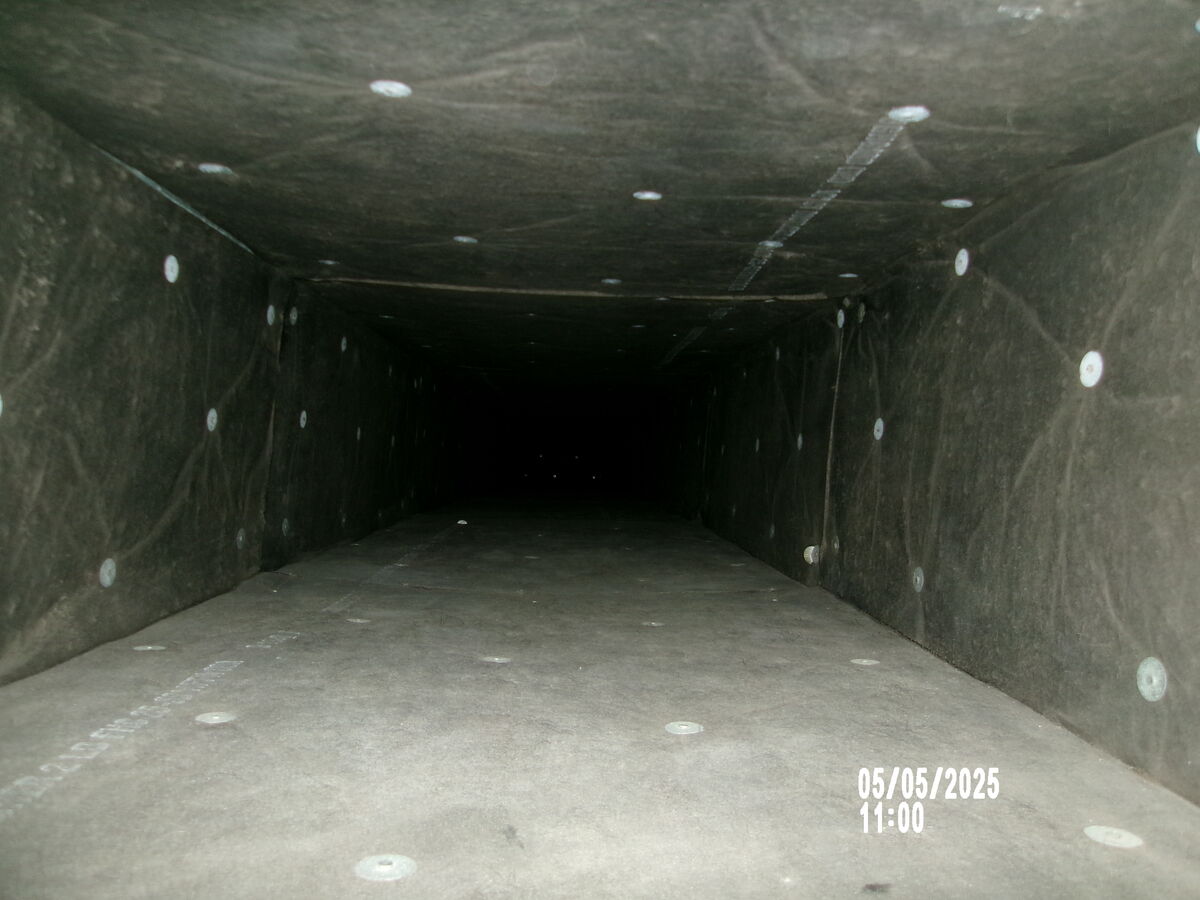
| 1. Assessment | Inspect the air handler, supply, return, and exhaust per ACR Section 1; document coil static pressure, drain pan condition, and duct condition with photographs | Establishes the need and the baseline the surveyor will compare against |
| 2. ICRA with infection prevention | Classify the activity and the served areas, obtain the permit, agree on precaution class, patient relocation, and shutdown windows | Required by The Joint Commission and CMS; defines the scope of containment |
| 3. Written work plan (ACR Section 2) | Scope, means and methods, schedule (usually nights and weekends), communication plan, product submittals with SDS, safety plan | Surveyors ask for it; it is also how the night shift knows what is happening above their ceiling |
| 4. Isolation | Seal supply and return diffusers in the served spaces, coordinate VAV or terminal box shutdown with the BAS, protect adjacent air handlers | Prevents dust migration into occupied rooms and positive pressurization of the work zone |
| 5. Containment and negative pressure | Barriers per the precaution class, HEPA negative air units exhausted outdoors where possible, manometer on the containment, HEPA scrubbing at a minimum of four air changes per hour, background particle count | ACR Level 2 or higher; ICRA Class IV or V |
| 6. Source removal | Mechanical agitation with continuous HEPA vacuum capture; coils cleaned from both faces and wet cleaned; pans and drain lines flushed and tested; fans, plenums, and dampers cleaned; damper positions marked and restored | The actual work; nothing else counts |
| 7. Verification | Visual inspection at minimum; NADCA Vacuum Test on disputed or critical surfaces; particle count compared to baseline; post-remediation verification before containment comes down | ACR Section 5; ICRA Table 6 |
| 8. Restart | New filters installed and old filters bagged, dampers verified at marked positions, infection prevention notified before start-up serving PE or AII rooms, clearance time observed before rooms return to service | CDC Category IB and IC recommendations |
| 9. Report | Before and after photographs, coil static pressure before and after, verification results with lab chain of custody if sampled, airflow and pressure confirmation, product list, ICRA closeout signatures | Closes the ICRA and gives the surveyor a document instead of a story |
The clearance time in step 8 comes from CDC’s table for removing airborne contaminants after a disturbance, assuming an empty room and perfect mixing:
| Air changes per hour | Minutes to 99 percent removal | Minutes to 99.9 percent removal |
|---|---|---|
| 4 | 69 | 104 |
| 6 | 46 | 69 |
| 12 | 23 | 35 |
| 15 | 18 | 28 |
| 20 | 14 | 21 |
An OR at 20 ACH is ready 21 minutes after a clean restart. A patient room at 4 ACH needs the better part of two hours, which is why patient room work is scheduled around census, not around the contractor’s calendar.
What Cleaning Actually Recovers
On an institutional air handler that has run a decade or more without coil restoration, the coil’s static pressure drop is typically well above its design value before the work and back near design after it. Airflow recovers with the pressure drop, which is where lost air changes come back, and latent capacity recovers with the fin surface, which is where summer OR humidity comes back into range. We measure all three before and after, and the numbers go in the report. Exhaust duct cleaning in isolation wings restores the negative pressure that the CDC background text describes losing. The difference between cleaning and restoration, and when a coil needs the second one, is covered in coil cleaning versus coil restoration.
Frequently Asked Questions
Q: Does CDC recommend duct cleaning in hospitals?
CDC recommends cleaning ventilation ducts as part of routine HVAC maintenance to ensure optimum performance (Category II) and cleaning duct grilles on a facility schedule when rooms are unoccupied. It does not endorse duct cleaning as an infection control intervention on its own, and neither do we.
Q: Does HVAC cleaning require an ICRA?
In a hospital, at minimum a documented ICRA classification, with an infection control permit required at Class III (Type C) and all Class IV and V work. The Joint Commission requires a process to manage air quality and infection control risk during repairs and maintenance, CMS expects the infection prevention program to monitor maintenance activities, and ASHRAE 170 requires an ICRA before HVAC systems in an existing facility are modified. ICRA 2.0 classifies limited non-dust-generating maintenance as Type A and multi-shift cleaning as Type C.
Q: What containment does NADCA require?
At minimum, negative pressure on the component being cleaned, with HEPA filtration on any vacuum equipment that exhausts indoors (Level 1). ACR does not assign containment levels by building type; in our practice, work in occupied healthcare areas runs at Level 2 or higher: polyethylene barriers, a manometer to validate negative pressure, HEPA air scrubbing at four air changes per hour or more, and post-remediation verification before the containment comes down.
Q: How is cleanliness verified?
By visual inspection immediately after cleaning and before restart, escalating to the surface comparison test or the NADCA Vacuum Test (0.75 milligrams per 100 square centimeters) when the visual result is disputed or the surface is critical.
Q: How often should hospital air handlers and ducts be inspected?
ACR 2025 recommends annual inspection of air handlers, supply ducts, and return and exhaust ducts in healthcare facilities, with cleaning based on the inspection findings rather than a fixed calendar.
What Happens Next
If your last HVAC cleaning project has no ICRA permit, no before-and-after static pressure readings, and no verification record, it was a service call, not a compliance document.
- Request an HVAC System Assessment. Air handler, coil, drain pan, supply, return, and exhaust inspection per ACR Section 1, with photographs and static pressure readings for each unit serving critical spaces.
- Receive a scope with the ICRA classification built in. Precaution class by air handler, shutdown windows, patient relocation needs if any, and a written work plan your infection preventionist can sign.
- Restore, verify, and document. Contained source removal, coil restoration where cleaning is not enough, cleanliness verification, restart coordinated with infection prevention, and a closeout report that satisfies ICRA Table 6, ACR Section 5, and the surveyor.
Contact us today to request your HVAC System Assessment, or call (570) 900-5827.