
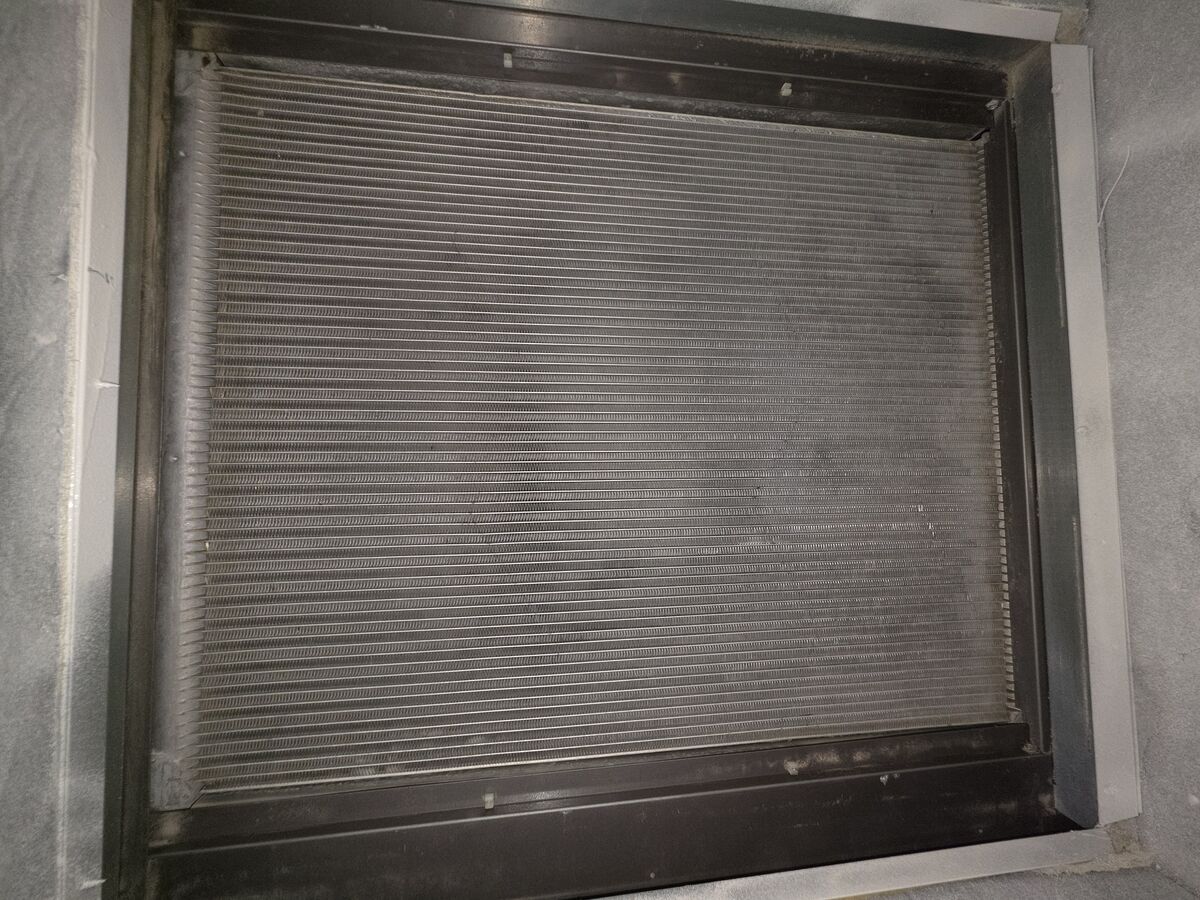
MERV Ratings in Healthcare: What ASHRAE 170 Actually Requires by Room, and the Filter Bank Mistakes That Fail Surveys
MERV 13 is the number everyone learned in 2020. In a hospital it is wrong in both directions. Here is what ASHRAE 170 requires for each space type, where the filters have to sit, which edition your OR is held to, and the installation mistakes that turn a compliant filter into a finding.
Every facility director learned one filter number during the pandemic: MERV 13. In a hospital that number is wrong in both directions. It is below what ASHRAE 170 requires for an operating room or a patient room, and above what it requires for a laundry, a soiled utility room, or a pharmacy. Installing the wrong efficiency is a finding. Installing the right efficiency in a rack that leaks around it is a finding that looks compliant on paper, which is worse.
This article lays out what ASHRAE 170 requires by space type, where the filter banks have to be located, which edition your building is held to, and the eight installation and maintenance mistakes we correct most often.
MERV in Sixty Seconds
MERV (Minimum Efficiency Reporting Value) comes from ASHRAE Standard 52.2, which tests a filter’s capture efficiency in three particle size ranges: 0.3 to 1 micron, 1 to 3 microns, and 3 to 10 microns. The ratings that matter in healthcare:
| Rating | Minimum capture | What it stops |
|---|---|---|
| MERV 8 | 70 percent of 3 to 10 micron particles | Dust, pollen, mold spores; protects coils |
| MERV 11 | 65 percent of 1 to 3 micron, 85 percent of 3 to 10 micron | Fine dust, most spores; the 62.1 outdoor air requirement in PM2.5 nonattainment areas |
| MERV 13 | 50 percent of 0.3 to 1 micron, 85 percent of 1 to 3, 90 percent of 3 to 10 | Bacteria carriers, smoke, most respiratory aerosols |
| MERV 14 | 75 percent of 0.3 to 1 micron, 90 percent of 1 to 3, 95 percent of 3 to 10 | The healthcare patient-care baseline |
| MERV 16 | 95 percent in all three ranges | The current OR final filter |
| HEPA | 99.97 percent at 0.3 micron | Protective environment rooms, burn units, terminal filters in specialty ORs |
Two footnotes. MERV-A (52.2 Appendix J) rates the filter after conditioning that removes the temporary benefit of electrostatic charge; ASHRAE Standard 241 requires MERV-A ratings for filter credit as of 2025, and it is the number to trust for a charged synthetic media filter. And ISO 16890 (ePM1, ePM2.5, ePM10) is an accepted alternative rating method in 62.1-2022; ASHRAE 170 references it but still states its requirements in MERV.
What ASHRAE 170 Requires by Space
Older editions of ASHRAE 170 (2008, 2013, and 2017 as originally published) carried a separate Table 6.4 with two columns, Filter Bank 1 and Filter Bank 2, by space category. That table was removed by an addendum in 2020, and since the 2021 edition the minimum filter efficiency is a column inside Table 7-1, one value per space. The 2025 edition, published in December 2025, keeps that structure.
| Minimum final filter (170-2021 and 2025) | Spaces |
|---|---|
| MERV 16 | Operating rooms, cesarean delivery rooms, Class 3 imaging rooms (hybrid OR level) |
| HEPA | Protective environment rooms and anterooms, combination AII/PE rooms, wound intensive care (burn) units, plus HEPA at the air terminal in orthopedic, transplant, neurosurgery, and burn ORs |
| MERV 14 | Patient rooms, critical care and ICU, NICU and nursery, airborne infection isolation rooms, ED exam and treatment rooms, trauma rooms, procedure rooms, Class 2 imaging, bronchoscopy, PACU, labor and delivery, patient care corridors |
| MERV 8 | Sterile processing decontamination and clean workrooms (MERV 14 where sterile items are packed into sterile packages; storage-only spaces may use MERV 8), sterile storage, pharmacy, general laboratories, soiled and clean holding, toilet rooms, ED waiting and triage, autopsy, laundry, Class 1 imaging, GI endoscopy, behavioral health rooms |
The pre-2021 values still matter, because most of the ORs in our territory were designed to them: Table 6.4 in the 2008 through 2017 editions required Bank 1 MERV 7 and Bank 2 MERV 14 for operating rooms and inpatient care spaces, MERV 7 and HEPA for protective environments, MERV 13 single-bank for laboratories and procedure rooms, and MERV 7 single-bank for administrative, storage, soiled holding, food preparation, and laundry areas.
Where the Filters Have to Sit
Section 6.4 of ASHRAE 170 is as important as the table and is violated more often.
- A MERV 8 prefilter upstream of the first heat exchanger surface in any air handler that combines return air from multiple rooms or introduces outdoor air. The prefilter protects the coils. A final filter alone, downstream, does nothing for the coil in front of it.
- The final filter downstream of all wet-air cooling coils and the supply fan for spaces that do not permit recirculation by room units and require MERV 14 or HEPA: operating rooms, procedure rooms, critical care, NICU, protective environment rooms, and isolation rooms. Placing the MERV 14 or 16 bank upstream of the coil means the air picks up whatever grows on the coil and drain pan after it has been filtered.
- Sealing interface surfaces for every HEPA filter and every filter rated MERV 14 or higher. The rack must seal the filter to the frame. A MERV 16 filter with a quarter-inch gap at the corners performs like a MERV 8.
- A pressure drop gauge on the final filter bank. The 2008, 2013, and 2017 editions required an installed manometer or differential pressure device on every filter bank above MERV 12. The 2021 edition dropped that sentence from Section 6.4 and carries it as an informative recommendation to inspect final filters for pressure drop and bypass monthly. Most existing hospitals were designed under the editions that require the gauge, and ASHRAE 62.1 expects quarterly pressure drop checks, so the gauge is not optional in practice.
- No duct liner downstream of the final filter for spaces requiring MERV 14 or HEPA.
- HEPA defined as 99.97 percent at 0.3 microns (IEST RP-CC001), with EN 1822 and ISO 29463 equivalents accepted since 2024.
Which Edition Applies to Your OR
The Joint Commission and CMS hold a space to the ASHRAE 170 edition in effect when it was designed. NFPA 99-2012 references 170-2008 for spaces constructed or with plans approved on or after July 5, 2016; older spaces are held to their original design basis if unaltered. Design and construction in Pennsylvania, New Jersey, and Maryland now run on the 2022 FGI Guidelines, which incorporate 170-2021.
So a 2015 OR designed to MERV 14 final filtration is compliant at MERV 14 today. A new OR or a renovated OR suite designed under FGI 2022 requires MERV 16.
Here is the trap. Facility teams read “MERV 16 for ORs,” swap MERV 16 filters into a rack and fan designed for MERV 14, and the added pressure drop pulls the air handler off its curve. Total air changes drop from 20 to 17, the pressure relationship weakens, and the survey finding is now air changes instead of filtration. Before upgrading a final filter bank, have the fan checked at the new pressure drop, or choose a MERV 16 product with a pressure drop close to the MERV 14 it replaces. Do not upgrade the filter and downgrade the air changes.
ASHRAE 62.1 for the Rest of the Campus
Administrative buildings, medical office buildings, and support facilities fall under ASHRAE 62.1, which sets three filtration requirements of its own:
- MERV 8 upstream of every cooling coil or wetted surface (Section 5.5), raised from MERV 6 in the 2013 edition.
- MERV 11 on outdoor air in PM2.5 nonattainment areas (Section 6.1.4.2). This is the requirement most likely to change under your feet. EPA lowered the annual PM2.5 standard from 12 to 9 micrograms per cubic meter in 2024; the D.C. Circuit upheld that rule on June 26, 2026, and if EPA finalizes designations under the 9 microgram standard, more of the mid-Atlantic may come into scope. Addendum h to 62.1-2022 (September 2025) adds an annual check of nonattainment status for exactly this reason.
- Ozone removal of at least 40 percent on outdoor air where the three-year average ozone concentration exceeds 0.100 ppm (Section 6.1.4.3).
For wildfire smoke events, which reached our territory in 2023, ASHRAE Guideline 44-2024 recommends MERV 13 filtration, minimized outdoor air with positive pressure maintained, and PM2.5 sensing.
Standard 241 and Filter Credit
ASHRAE Standard 241-2023, Control of Infectious Aerosols, gives facilities a way to calculate an equivalent clean airflow rate per person during an infection risk management mode. Filtered recirculated air counts toward it in proportion to the filter’s MERV-A rating: MERV-A 13 earns 77 percent credit, MERV-A 14 earns 88 percent, MERV-A 16 earns 95 percent, HEPA earns 99 percent, and anything below MERV-A 11 earns nothing. A hospital’s MERV 14 and MERV 16 final filters already do most of the work; the value of 241 is that it gives you a documented Building Readiness Plan that says so before the next respiratory season.
The Eight Filter Bank Mistakes That Fail Surveys
- Bypass. Collapsed gaskets, missing clips, filters shorter than the rack, and racks racked out of square. The air takes the path of least resistance, which is around the media. CDC’s environmental infection control guideline specifically calls for filters to be installed and maintained to prevent air leakage and dust overloads.
- Wrong efficiency for the zone. MERV 13 in a patient care air handler that requires MERV 14, or MERV 8 pleats in a bank feeding an OR because that is what the storeroom had.
- Final filter upstream of the coil. Usually a legacy layout or a retrofit that never got corrected. The coil and pan become the last thing the air touches before the patient.
- Calendar changes instead of gauge changes. Filters changed on the first of the month regardless of pressure drop, so some are replaced clean and others run past their final resistance until the fan cannot deliver design airflow.
- No gauge, or a gauge nobody reads. The editions most existing hospitals were designed to require the device on banks above MERV 12. Surveyors ask what the current reading is and what the change-out setpoint is.
- HEPA filters never leak tested. A HEPA in a protective environment room or a specialty OR terminal should be scan tested after installation and periodically thereafter. A certificate from the factory proves the media, not the installation.
- Changing filters with the system running and without bagging. CDC recommends bagging dust-loaded filters immediately upon removal to prevent dispersal of dust and fungal spores during transport, and coordinating shutdowns with infection prevention. Pulling a loaded prefilter with the fan on sends a burst of everything it captured down the duct.
- No record of what is installed. The simplest survey question is “what MERV is in AHU-7?” If the answer requires a ladder, you do not have a filter program.
How to Verify Your Filter Program
| Check | Method | Record to keep |
|---|---|---|
| Installed efficiency per bank | Read the filter label, compare against the space list served by the unit | Filter schedule by AHU, updated at every change |
| Bank location | Confirm prefilter ahead of the first coil and final filter after the coil and fan | Annotated AHU diagram in the O&M manual |
| Seal integrity | Inspect gaskets and clips at every change; light test in the dark; particle count downstream on HEPA banks | Change-out log with condition notes |
| Pressure drop | Gauge reading at each change and at least quarterly (ASHRAE 62.1 has required quarterly pressure drop checks since 2022, and Addendum h added a quarterly fit and seal check in 2025) | Logged readings with the change-out setpoint |
| HEPA performance | PAO or DOP scan test after installation and on a schedule set with infection prevention | Test certificates by filter serial number |
| Airflow after a MERV upgrade | Measure supply cfm and recompute air changes | Balance report addendum |
Frequently Asked Questions
Q: What MERV rating do hospitals require?
It depends on the space. Under ASHRAE 170-2021 and 2025, operating rooms require MERV 16 final filtration, most patient care and treatment spaces require MERV 14, support spaces require MERV 8, and protective environment rooms and burn units require HEPA. A MERV 8 prefilter is required upstream of the coils in any air handler that mixes return air from multiple rooms or brings in outdoor air.
Q: Is MERV 13 enough for a hospital?
Not for patient care air handlers. MERV 13 sits below the MERV 14 baseline for patient rooms, ICUs, and isolation rooms. It may be appropriate for administrative buildings and, under Guideline 44, for wildfire smoke response.
Q: Do operating rooms require HEPA filters?
Not as a general rule. ORs require MERV 16 under the current editions (MERV 14 under editions before 2021). HEPA filters at the air terminal are required for orthopedic, transplant, neurosurgery, and burn operating rooms.
Q: Where should the final filter be located?
Downstream of the cooling coils and the supply fan for spaces that require MERV 14 or HEPA and do not permit recirculating room units, with sealing interface surfaces for MERV 14 and above, and a pressure drop gauge on the bank (required outright by the 2008 through 2017 editions, recommended by the 2021 edition).
Q: Can I upgrade an existing OR from MERV 14 to MERV 16?
Yes, if the air handler can deliver design airflow at the higher pressure drop. Verify fan capacity and re-measure total air changes after the change. An upgrade that lowers ACH below 20 trades a non-finding for a finding.
What Happens Next
Not sure what is in your racks, or whether the racks are sealing? Two ways to start.
- Run your air handlers through the Filter Match Wizard on our Tools & Calculators page to see the required efficiency for the spaces each unit serves.
- Request a Filtration Assessment. Our technicians document installed efficiency, bank location, seal condition, pressure drop, and gauge status for every air handler serving patient care spaces, and measure airflow so a filter change never becomes an air change finding.
- Put the program on paper. A filter schedule by unit, change-out setpoints, HEPA test records, and a change procedure coordinated with infection prevention, delivered in a format your surveyor can read in five minutes.
Contact us today to request your Filtration Assessment, or call (570) 900-5827.