
Operating Room Humidity: ASHRAE 170, the CMS 20 Percent Waiver, and the Logs Surveyors Ask For
Temperature and humidity out of range with no documented corrective action was one of the most common physical environment findings in 2025 hospital surveys. Here is the range, the waiver, the IFU risk assessment, the monitoring surveyors expect, and the mechanical reasons an OR drifts out of range in both seasons.
When The Joint Commission published its analysis of 2025 hospital survey findings in January 2026, temperature and humidity out of range in operating rooms and sterile areas, “with a lack of corrective action or documentation explaining the deviations,” was one of the recurring physical environment themes. Surveyors found it two ways: real-time readings during the OR suite walk, and retrospective review of the logs.
OR humidity fails in two seasons. In January the room drops below 20 percent because the humidifier cannot keep up. In July it climbs past 60 percent because the cooling coil cannot pull enough moisture out of the air. This article covers the numbers and where they came from, the CMS waiver that lets you run at 20 percent and the conditions attached to it, the manufacturer instructions-for-use problem that trips facilities after they take the waiver, what monitoring surveyors actually expect, and the mechanical causes we fix.
The Numbers and Where They Came From
ASHRAE 170 sets the operating room design range at 20 to 60 percent relative humidity and 68 to 75°F, with each OR on its own temperature control. Those values are unchanged in the 2017 and 2021 editions, and ASHE’s summary of the 2025 changes does not touch them, but they have a history that still shows up in survey conversations.
| Year | Requirement | Source |
|---|---|---|
| 1999 | Minimum 35 percent RH in anesthetizing locations | NFPA 99-1999, Section 5-4.1.1, enforced by CMS until 2016 |
| 2008 | 30 to 60 percent | ASHRAE 170-2008 as published |
| 2010 | 20 to 60 percent for ORs, cystoscopy, cesarean delivery, treatment, trauma, laser eye, Class A procedure, and GI endoscopy rooms | Addendum d to ASHRAE 170-2008, approved June and July 2010; ASHRAE concluded, as CMS later summarized it, that a 20 percent minimum would not adversely affect system performance, patient safety, or clinical outcomes |
| 2013 | CMS permits 20 percent minimum in hospitals and CAHs by categorical waiver | S&C 13-25-LSC |
| 2016 | CMS adopts NFPA 99-2012, which references ASHRAE 170-2008 with its addenda, for new and renovated spaces | 81 FR, effective July 5, 2016 |
| 2017 to 2025 | 20 to 60 percent unchanged | ASHRAE 170-2017, 2021, 2025 |
Related spaces have their own ranges, and surveyors check them on the same walk: procedure rooms and cesarean delivery 20 to 60 percent, critical care 30 to 60 percent, burn units 40 to 60 percent, sterile storage and sterile processing clean workrooms a maximum of 60 percent.
Note k of Table 7-1 says the RH values are the minimum and maximum allowable at any point within the design temperature range. The Joint Commission’s FAQ on OR temperature adds that when a surgeon requests a temporarily higher or lower room temperature, there is still an expectation that relative humidity remain below 60 percent.
The CMS Categorical Waiver, and Whether You Still Need It
CMS issued S&C 13-25-LSC on April 19, 2013. It permits new and existing ventilation systems serving hospital and critical access hospital anesthetizing locations to operate at 20 percent RH or higher instead of the 35 percent the 1999 code required, and recommends RH not exceed 60 percent. The conditions are specific:
- Document the election in writing before the survey. It is not acceptable to invoke a waiver after a citation has been issued.
- Notify the survey team at the entrance conference of every survey assessing Life Safety Code compliance.
- Monitor RH in anesthetizing locations and be able to provide evidence that levels are maintained at or above 20 percent.
- The waiver does not apply where state or local law requires more stringent control, or where reducing RH would negatively affect ventilation system performance.
- Ambulatory surgical centers are not subject to the same LSC provisions and do not need the waiver, but must maintain OR humidity in accordance with nationally accepted guidelines.
Do you still need it after CMS adopted NFPA 99-2012 in 2016? In our reading, for a space designed after July 5, 2016, NFPA 99-2012 takes you to ASHRAE 170-2008 with Addendum d, so 20 percent is the design minimum without a waiver; CMS’s current interpretive guidance says ventilation standards “may permit” reduction to 20 percent. For an older OR, the question is what the space was designed to. The Joint Commission’s FAQ on categorical waivers, updated April 2026, says that many CMS waivers became unnecessary after the 2016 adoption, but The Joint Commission still recognizes S&C 13-25-LSC and requires strict compliance with its provisions. The organization documents invocation in its EC committee minutes or management plan, identifying the S&C letter, the locations it applies to, and an attestation that it has reviewed and complies with the referenced code. Surveyors field-validate the conditions.
Our advice: if any OR in your facility was designed to a 30 or 35 percent minimum, keep the waiver election on file in the EC committee minutes or management plan, keep it in your Basic Building Information as well (the 2025 manual required that, and it costs nothing), and mention it at the entrance conference. It removes an argument.
The IFU Problem: The Waiver Is Not the Whole Answer
Running an OR at 22 percent solves the facilities problem and creates a supply chain problem. In February 2015, CMS issued S&C 15-27 to say so: an RH below 30 percent is not compatible with the instructions for use for some sterile supplies and electro-medical equipment, hospitals are expected to follow current IFUs, and failure to adhere to IFUs must be cited even if the facility has opted to use the waiver.
The basis was a Joint Communication released January 5, 2015 by twelve collaborating organizations, including ASHRAE, ASHE, AORN, AAMI, AHA, and the American Society of Anesthesiologists, following a stakeholder meeting AAMI convened in October 2014 with CMS, FDA, and The Joint Commission in the room. Its key points:
- Required environmental RH for supplies and equipment is stated in the manufacturer’s IFU.
- Biological indicators, chemical indicators, and EKG electrodes are particularly humidity sensitive; some older electro-medical equipment is as well.
- ASHRAE 170 is a design standard; there is no expectation to maintain design values 100 percent of the time.
- Before running below 30 percent, assess the impact on the supplies and equipment in use.
The Joint Communication lists eight risk assessment questions. Condensed, they ask: what minimum RH you want and what your system can actually hold; how often and how long RH actually falls below 30 percent, from data; what the IFU says for each item stored or used in the OR; what the risk is of using an item that calls for 30 percent or higher; what excursion data the manufacturer can provide; what future supplies will require; whether the benefit of running below 30 percent outweighs the risk; and, if you proceed, whether humidity-sensitive supplies should move to a humidity-controlled closet.
The Joint Commission’s survey heads-up reports have flagged exactly this gap: organizations that adopted the waiver but had not completed the risk assessment showing that supplies and equipment can be used and stored at those humidity levels. Do the assessment with perioperative services, infection prevention, sterile processing, supply chain, and clinical engineering at the table, and keep the sign-off.
Monitoring: What Is Required Versus What Surveyors Expect
Neither ASHRAE 170 nor FGI sets an operational logging frequency; they are design documents. The requirements come from CMS and the accreditors.
CMS interpretive guidance at A-0726, revised in 2026, states that hospitals must maintain records demonstrating they are maintaining required temperature, humidity, and airflow levels, and instructs surveyors to review those records for ORs and associated ancillary rooms and confirm timely corrective action for out-of-range readings.
The Joint Commission’s FAQ on temperature and humidity monitoring (updated December 2025) is the clearest statement available, and it is worth reading closely:
- There is no prescriptive requirement for daily logging unless a controlling authority or your own policy requires it.
- Critical rooms, meaning rooms where invasive procedures are performed or sterile items are stored, must be in constant compliance when in use for their intended purpose.
- Some reliable strategy must exist to ensure continuous compliance: daily readings, real-time indicators in the space, or BAS alarming, as long as there is a means to identify an adverse condition (a person at the monitoring station, an alarm, a page).
- Daily readings are acceptable if the organization has assessed that the snapshot represents conditions throughout the operational day.
- Non-continuous readings must be logged. All non-compliant conditions must be documented with corrective actions.
- If a room is placed in a non-compliant energy conservation mode when unoccupied, it must be validated compliant before a procedure begins, and the setback mode must still maintain proper RH.
| Monitoring approach | Meets expectation when | Common gap |
|---|---|---|
| BAS trending with alarms | Alarm routes to a person who responds, response is documented | Alarms suppressed after nuisance events; no record of response |
| Wall-mounted hygrometer read by OR staff | Reading logged daily with time, excursions escalated to facilities | Logged only on weekdays; no escalation path |
| Facilities rounds | Readings logged with instrument ID, excursions documented with cause and correction | Rounds skip weekends; instrument never calibrated |
| Any of the above | Excursion response defined in policy with time thresholds | Policy says “monitor,” never says “and then what” |
ASHRAE’s TC 9.6 offered a practical response framework in 2019: designate a perioperative decision team (at minimum a facility engineer, an infection preventionist, and a perioperative professional), document the facility’s RH range, and set time-based triggers. Their suggested thresholds: if RH is up to 5 percent outside the limit for more than 6 hours, the facility engineer takes corrective action; more than 12 hours, convene the team; more than 24 hours, the team considers halting operations for repairs; if RH is more than 5 percent outside the limit for more than 2 hours, the engineer acts and convenes the team immediately. Adopt something like it, write it into policy, and surveyors stop asking “and then what.”
When the OR Reads 63 Percent in July
High OR humidity is almost always a latent capacity problem, and latent capacity is the first thing a cooling coil loses.
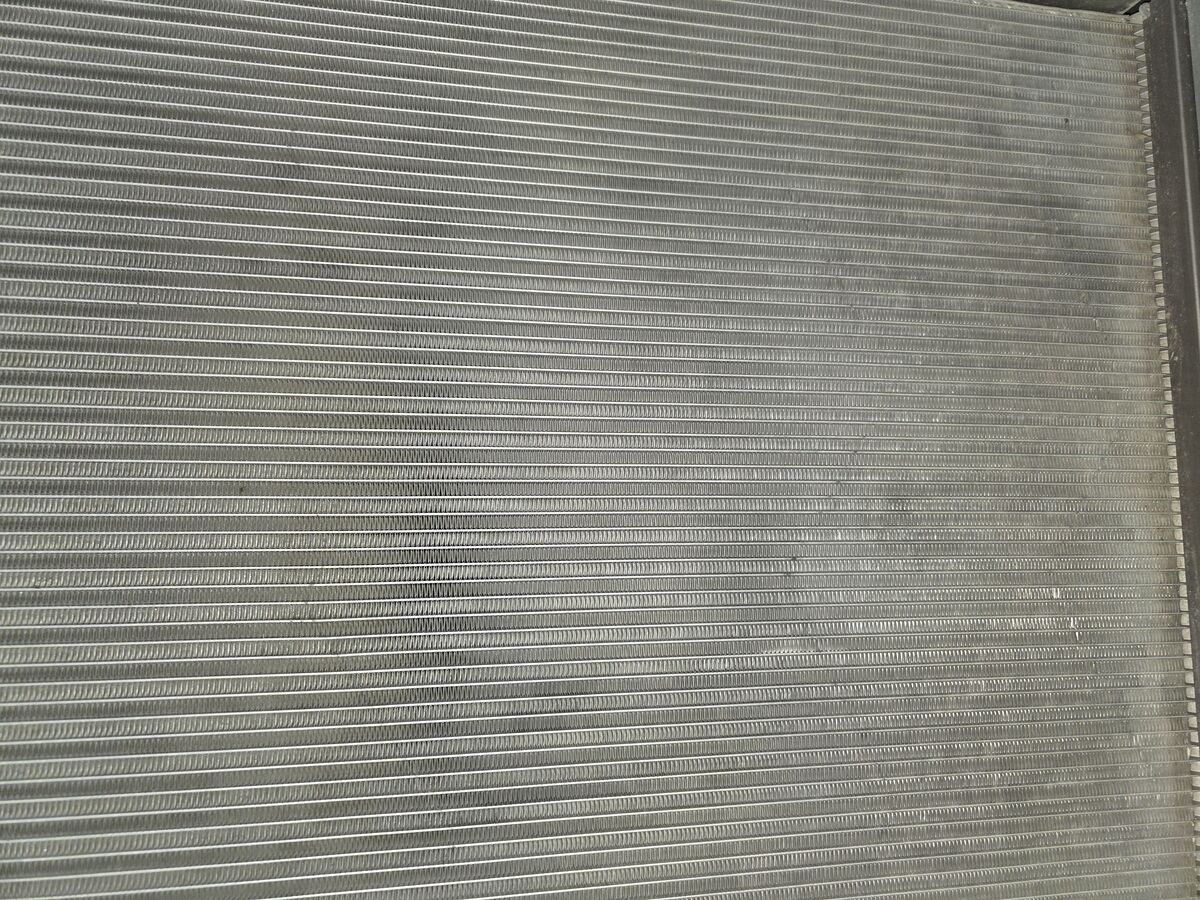
A clean coil at design chilled water temperature delivers supply air with a dew point in the low 50s or below, which is what it takes to hold a 68°F room under 60 percent once people, instruments, and irrigation add moisture. As the coil fouls, the fin surface stops transferring heat, the leaving air temperature creeps up, and the air leaves the coil holding more moisture. The room still reaches setpoint because the reheat and the thermostat compensate for sensible load. Humidity does not have a thermostat. We covered the mechanism in how dirty coils increase static pressure and energy spend; the humidity effect is the same story on the latent side.
The other causes we find, in order of frequency:
- Chilled water supply temperature reset upward for energy savings, which raises coil leaving dew point.
- Coil bypass: air passing around the coil through gaps in the frame or blank-off panels.
- Economizer or outdoor air damper admitting humid air at part load.
- VAV turndown at low load reducing airflow across the coil until it no longer dehumidifies.
- Humidifier overshoot from a control that never got a summer lockout.
- Envelope infiltration through corridor doors and above-ceiling openings pulling in humid air.
Coil restoration is the fix for the first cause and the prerequisite for diagnosing the others: you cannot troubleshoot controls on a coil that cannot meet its design leaving air temperature. After restoration, verify leaving air temperature and dew point at design chilled water conditions, check reheat, seal the bypass, and confirm the room holds 60 percent or below at full occupancy.
When the OR Reads 18 Percent in January
Low humidity is a capacity and control problem on the humidifier side: undersized steam humidifiers for the outdoor air fraction, poor steam quality, controls tuned for a narrow band, or absorption distance too short so the moisture condenses in the duct instead of reaching the room. The waiver gets you to 20 percent; it does not get you to 18. Below 20 you are outside the waiver’s floor, and the waiver requires evidence of timely, documented correction. Above 20 but below 30, the IFU assessment governs, and moving humidity-sensitive supplies to a controlled closet is the cheapest fix available.
The Documentation Package
| Item | Contents |
|---|---|
| Design basis | ASHRAE 170 edition and RH range each OR was designed to |
| Waiver election (if applicable) | EC committee minutes or management plan entry naming S&C 13-25, the locations, and the compliance attestation; entry in Basic Building Information |
| IFU risk assessment | Inventory of humidity-sensitive supplies and equipment with IFU ranges, decision record, and supply relocation if applicable |
| Monitoring policy | Method, frequency, responsible party, and time-based excursion response |
| Records | Logs or BAS trends covering nights and weekends, with every excursion annotated with cause and correction |
| Mechanical verification | Coil condition, leaving air temperature and dew point, humidifier capacity check, dated |
Frequently Asked Questions
Q: What is the required humidity range for an operating room?
ASHRAE 170 sets a design range of 20 to 60 percent relative humidity at 68 to 75°F. Spaces designed before Addendum d to the 2008 edition may have been designed to a 30 percent minimum, and CMS enforced a 35 percent minimum until 2016.
Q: Do we still need the CMS categorical waiver for 20 percent humidity?
For spaces designed after July 5, 2016, the design minimum is already 20 percent. For older spaces, The Joint Commission still recognizes S&C 13-25 and expects strict compliance with its conditions if you rely on it. Keeping the election documented and announcing it at the entrance conference is the conservative course.
Q: Is a daily humidity log required?
Not by The Joint Commission as a prescriptive rule, but critical rooms must be in constant compliance when in use and you must have a reliable way to prove it. Non-continuous readings must be logged, and every out-of-range condition must be documented with corrective action. CMS expects records demonstrating required levels are maintained.
Q: What happens if a surveyor finds the OR at 62 percent?
Expect a finding unless you can show the excursion was identified, the response your policy requires was taken, and the cause was corrected. The 2026 building tour guidance reviews the OR suite early so the organization has a chance to correct on site, and requires documentation that other areas on the same air handler were not affected by the correction.
Q: Why does our OR humidity only fail in summer?
Because the cooling coil has lost latent capacity. Fouled fins, raised chilled water temperature, coil bypass, or low airflow at part load all raise the coil’s leaving dew point. Coil restoration and verification of leaving air conditions is where we start.
What Happens Next
If your OR humidity logs have gaps on weekends, or your summer readings sit at 58 to 63 percent and nobody has looked at the coil, the fix is measurable and it is not a new air handler.
- Request an OR Environmental Assessment. We measure coil leaving air temperature and dew point, static pressure, airflow, and room RH under load, review your monitoring records and waiver documentation, and identify the mechanical cause of every excursion pattern.
- Receive a findings report with the compliance package. Design basis, monitoring gaps, IFU assessment status, and corrective actions, written for the surveyor’s document review.
- Restore latent capacity and verify. Coil restoration, bypass sealing, control verification, and post-work confirmation that each OR holds range at design conditions, with the air-handler-level documentation the building tour requires.
Contact us today to request your OR Environmental Assessment, or call (570) 900-5827.