
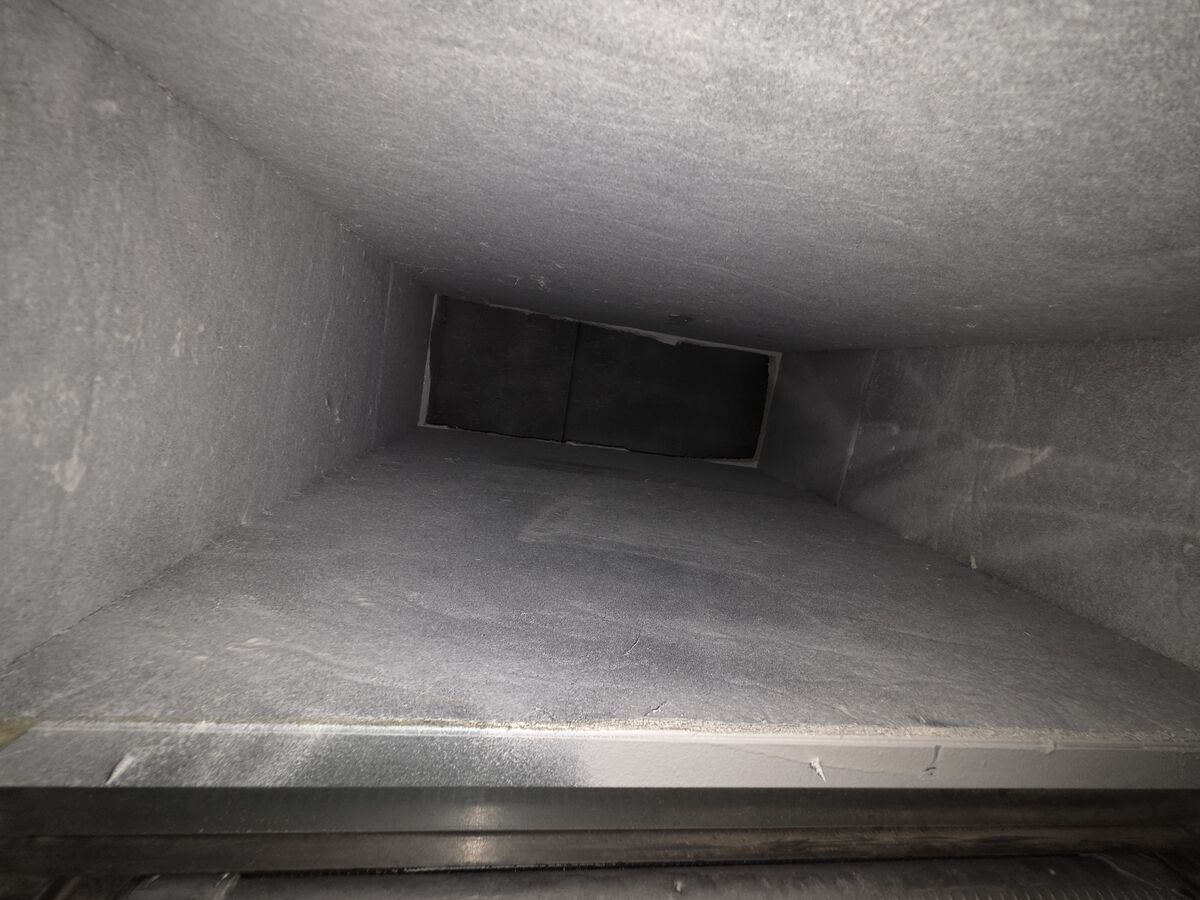
Fire and Smoke Damper Inspections in Hospitals: NFPA 80, NFPA 105, and the Documentation Surveyors Actually Read
The six-year hospital cycle is the easy part. The findings come from what the test skipped, what the report left out, and the dampers nobody can reach. A field-level guide to NFPA 80 and 105 damper inspections for healthcare facility directors.
Our earlier article on fire damper compliance and Joint Commission surveys covered why dampers fail and what a defensible program looks like. This one goes into the parts that produce the findings: the exact testing cycle and where it comes from, what a test has to include to count, what the report has to contain, and what to do about the dampers you cannot reach.
It also corrects a claim you will see repeated across the industry, including in vendor literature: that smoke dampers require annual testing. Under the code editions CMS and The Joint Commission enforce, they do not, and understanding why tells you a lot about how damper compliance actually works.
The Testing Cycle and Where It Comes From
CMS adopted the 2012 Life Safety Code (NFPA 101-2012) and the 2012 Health Care Facilities Code (NFPA 99-2012) effective July 5, 2016. NFPA 101-2012 sends HVAC to Section 9.2, which references NFPA 90A-2012, which sends damper maintenance to NFPA 80-2010 Chapter 19 (fire dampers) and NFPA 105-2010 Chapter 6 (smoke dampers). The Joint Commission’s former EP on dampers cited exactly those three sections.
| Damper type | Occupancy | Cycle | Source |
|---|---|---|---|
| Fire damper | Hospital | 1 year after installation, then every 6 years | NFPA 80-2010, 19.4.1 and 19.4.1.1 |
| Fire damper | Nursing home, ASC, freestanding business occupancy | 1 year after installation, then every 4 years | NFPA 80-2010, 19.4.1.1 |
| Smoke damper | Hospital | 1 year after installation, then every 6 years | NFPA 105-2010, 6.5.2 |
| Smoke damper | Nursing home, ASC, freestanding business occupancy | 1 year after installation, then every 4 years | NFPA 105-2010, 6.5.2 |
| Combination fire/smoke damper | Same as above by occupancy | Same as above | NFPA 80 and NFPA 105 both apply |
| Dampers in an engineered smoke control system (dedicated) | Any | Semiannual | NFPA 92 and IFC 909 |
| Dampers in an engineered smoke control system (non-dedicated) | Any | Annual | NFPA 92 and IFC 909 |
Two points facility directors regularly get wrong.
The six-year interval belongs to hospitals only. A skilled nursing facility, even one on a hospital campus, is on the four-year cycle. Business occupancies inside a hospital building are generally treated as part of the hospital, but the codes say only “except in hospitals,” so confirm with your AHJ; a freestanding medical office building follows four.
The clock starts at the last documented test. CMS said this explicitly when it first permitted the six-year interval in 2009: the interval commences on the date of the last documented damper test. No documentation means no start date, which surveyors treat as no test.
The current editions of NFPA 80 (2025) and NFPA 105 (2025) keep the same 1, 4, and 6 year intervals. They renumbered the sections and added provisions for remote inspection and inaccessible dampers, which we address below.
The Annual Smoke Damper Myth
NFPA 105-2010 puts smoke dampers on the identical cycle as fire dampers. The claim that smoke dampers need annual testing comes from four places, and it is worth knowing which one applies to your building:
- Engineered smoke control systems. Dampers that are part of a stairwell pressurization or atrium smoke control system are tested with that system under NFPA 92: semiannually for dedicated systems, annually for non-dedicated systems. If you have a smoke control system, its dampers are on the annual or semiannual schedule. Passive smoke dampers in smoke barriers are not.
- Actuator manufacturer intervals. NFPA 105-2010 requires the actuator to be cycled at the interval recommended by the actuator manufacturer, which for some products is more frequent than the periodic test.
- Annual fire door inspection. NFPA 80-2010 Chapter 5 requires annual inspection of fire door assemblies, and CMS set a January 1, 2018 compliance date for it (S&C 17-38-LSC, July 2017). That memo contains no mention of dampers, but the two get conflated constantly.
- Local and foreign codes. Some municipal codes require annual damper testing, and Canada’s National Fire Code requires an annual visual inspection. Confirm with your local fire marshal, and see the Delaware note below.
If a vendor proposes annual smoke damper testing for your hospital, ask which code section requires it. The answer will usually be one of the four above, and only the first one is likely to apply.
What a Test Has to Include
A visual look through an access door is not a test. NFPA 80-2010 Section 19.4 and NFPA 105-2010 Section 6.5, as enforced by state life safety surveyors, require the following for each damper:
- Verify full, unobstructed access to the damper before anything else.
- Remove the fusible link on fire dampers and combination dampers and confirm the damper closes fully under its own operation.
- Reinstall the link after the test, or replace it with a link of the same size, temperature rating, and load rating if it is damaged or painted.
- Inspect the frame and blades for rust, bending, misalignment, damaged hinges, or foreign objects penetrating the frame.
- Confirm nothing blocks closure: screws in the blade track, duct liner, wiring, insulation, or construction debris.
- Dry lubricate exposed moving parts as the manufacturer requires.
- Test smoke and combination dampers under normal HVAC airflow and cycle the actuator at the interval the actuator manufacturer recommends.
- Investigate reports of abrupt changes in airflow or noise from the duct system.
The 2019 and later editions add two steps that competent inspectors already perform and that you should require in your scope: for actuated dampers, remove power or air, confirm full closure, restore power or air, and confirm return to the full-open position; and verify that any position indicating devices report open and closed to the intended location.
Every one of those steps generates a data point the report needs.
The Report Surveyors Actually Read
NFPA 80-2010 Section 19.4.9 requires all inspections and testing to be documented with the location of the damper, the date of inspection, the name of the inspector, and the deficiencies discovered, with a space to indicate when and how each deficiency was corrected. Section 19.4.10 requires the documentation to be maintained and made available to the authority having jurisdiction. NFPA 105-2010 Sections 6.5.11 and 6.5.12 mirror those requirements for smoke dampers.
The Joint Commission layers seven documentation elements on top, carried in the 2026 hospital manual at PE.04.01.01 EP 2 Note 1 (since March 1, 2026) and PE.03.01.01 EP 3 Note 4: name of the activity, date, inventory of devices, required frequency, name and contact information of the person who performed it, the NFPA standard referenced, and results. The Survey Process Guide’s document list places damper testing under PE.04.01.01 EP 2. State agency surveyors write the same deficiency under CMS tag K521 (HVAC, NFPA 101-2012 Section 9.2).
| Report element | Why it matters at survey |
|---|---|
| Unique damper ID and location (floor, room, barrier, duct) | Ties each test to the life safety drawings; proves the inventory is complete |
| Damper type and rating (fire, smoke, combination; 1.5-hour or 3-hour) | Establishes which standard and which test applies |
| Access condition | Documents inaccessible dampers and the plan to correct them |
| Test method (link removed, actuator cycled, airflow condition) | Separates a functional test from a visual glance |
| Result: full close and reopen confirmed | The pass/fail record surveyors check first |
| Deficiencies found | Required by NFPA 80 19.4.9 |
| Correction: what was done and when | Required by NFPA 80 19.4.9; open items become findings |
| Inspector name, contact information, company, and qualification | Name and contact information required by The Joint Commission; qualification increasingly requested |
| Photographs (open and closed) | Not required by code, but the fastest way to end a debate on survey day |
Keep the reports for the life of the dampers. NFPA text says “maintained and made available”; the Minnesota Department of Health, one of the more thorough state life safety agencies, advises keeping them for the life of the damper, and we agree.
Inaccessible Dampers: The Number One Deficiency
The most common damper problem in hospitals built before 2000 is not a broken damper. It is a damper nobody can reach. Ceilings were hard-decked, mechanical chases were closed in, and access doors were drywalled over during renovations.
NFPA 90A-2012 Section 4.3.5.1 requires a service opening adjacent to each damper, large enough for maintenance and resetting, identified with letters at least one-half inch high indicating the damper location, with corresponding openings in walls and ceilings. The annex recommends at least 18 by 16 inches, or 24 by 16 inches where entry is needed. The 2010 editions of NFPA 80 and 105 contain no exemption for inaccessible dampers.
The 2019 editions added both a limited exemption for a single inaccessible damper in an existing fully ducted system and a remote inspection method for actuated dampers with positive open and closed indication; the 2022 editions added documentation and qualified-person requirements, and the 2025 editions added visual inspection through remote methods and a performance-based option. CMS and The Joint Commission enforce the 2010 editions through the 2012 Life Safety Code, and we have not found any authoritative statement that deemed-status hospitals may rely on the newer exemptions. Treat them as a conversation with your AHJ, not a plan.
One contractor’s published account from a large Pacific Northwest hospital illustrates the scale: in a single building, 350 of 374 dampers could not be inspected on the first pass because of access. That is the normal starting point, not the exception.
The workable sequence:
- Inventory from the drawings, then verify in the field. Every rated barrier penetration by ductwork is a candidate damper location.
- Classify access for each damper: accessible, restricted (ceiling tile or lift required), or inaccessible (hard ceiling, chase, or buried).
- Cut access for the inaccessible group, coordinated with infection prevention under an ICRA, using rated access doors where the opening is in a rated assembly.
- Test and document in the same mobilization, so the access work and the test share a date.
Why Dampers Fail
Industry-reported failure rates run high. One national life safety contractor reports that roughly 22 percent of dampers fail a routine inspection, and a Seattle mechanical contractor cites studies putting the failure rate at about 55 percent within the first ten years. The specific causes are mundane: screws driven into the blade track during duct installation, broken or disconnected linkages, racked frames from duct movement, corrosion from humidity or coil carryover, blades propped open with wood or wire, painted-over links, and actuators with no air, no power, or a failed spring. Almost all of them are correctable in place without replacing the damper.
State Notes for Our Territory
Delaware enacted its own statute in 2022 (16 Del. C. Chapter 66D). Dampers must be inspected one year after installation and every four years thereafter, every six years in hospitals, using the visual inspection method in NFPA 80 and 105 (remote-only inspection is not accepted). Inspections must be performed by fire department personnel or a technician holding the ICB HVAC Fire Life Safety credential or an equivalent ISO/IEC 17024 accredited certification, deficiencies must be corrected within 30 days, a certificate of operation must be kept on the property, copies go to the municipal or State Fire Marshal within 30 days, and violations carry a civil penalty of $100 per day.
Pennsylvania, New Jersey, and Maryland apply the NFPA cycles through CMS and accreditation. Pennsylvania’s Uniform Construction Code moved to the 2021 International Codes on January 1, 2026, which affects new construction and access door requirements but not the ITM cycle for existing dampers. We found no state health department in our territory that imposes a more frequent cycle than NFPA for hospitals or nursing homes.
Inspector qualification is receiving more attention from surveyors. The International Certification Board’s HVAC Fire Life Safety Technician credential is the most widely recognized, and ASHE has written about qualification options for hospitals. Ask for the credential before you sign the contract.
Frequently Asked Questions
Q: How often must fire dampers be tested in a hospital?
One year after installation, then every six years, under NFPA 80-2010 as enforced through the 2012 Life Safety Code. Nursing homes, ambulatory surgery centers, and freestanding business occupancies are on a four-year cycle.
Q: Do smoke dampers have to be tested every year?
Not under NFPA 105-2010, which uses the same one, four, and six year cycle as fire dampers. Annual or semiannual testing applies to dampers that are part of an engineered smoke control system under NFPA 92, and some local codes require more frequent testing.
Q: What if a damper cannot be accessed?
Under the 2010 editions there is no exemption; the expectation is that access is created and the damper tested. Document the inaccessible damper, the plan and schedule to gain access, and complete the test. Newer NFPA editions contain limited exemptions and remote inspection options that CMS has not adopted.
Q: What tag does CMS use for damper deficiencies?
K521 (HVAC), which cites NFPA 101-2012 Sections 18/19.5.2.1 and 9.2, and through them NFPA 80 Section 19.4 and NFPA 105 Section 6.5.
Q: Can our in-house staff perform the inspections?
The 2010 editions require the work to be done safely, with proper PPE, and documented; the 2022 editions added an explicit qualified-person requirement, and Delaware requires a certified technician by statute. Most hospitals use a certified contractor because the inventory, access, testing, and report have to hold up to both a life safety surveyor and a state fire marshal, and because the six-year cycle rarely lines up with in-house staffing.
What Happens Next
If your last damper report is missing dates, inspector names, or the deficiency corrections, or if you have a list of dampers marked “unable to access,” your next survey already has a finding on it.
- Request a Damper Compliance Assessment. We build or verify your inventory against the life safety drawings, classify access for every damper, and identify the ones your six-year clock is running against.
- Receive an access and testing plan. Prioritized by barrier rating and survey exposure, coordinated with infection prevention under an ICRA, with rated access doors where required.
- Test, correct, and document. Functional testing to NFPA 80 and 105, in-place repairs, and a report built around the NFPA 80 19.4.9 fields and The Joint Commission’s seven documentation elements.
Contact us today to request your Damper Compliance Assessment, or call (570) 900-5827.